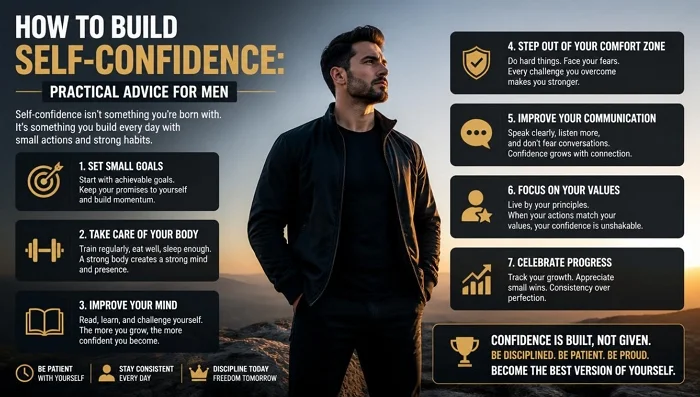
We all want more confidence. The reason is simple: confidence helps us move through life with less fear and more clarity. It makes it easier to speak up, try something new, meet people, and keep going when things do not work out the first time.
Think of confidence as fuel. You may have talent, ambition, and a great deal of potential, but without enough confidence, it can be difficult to put those qualities into action.
The good news is that confidence is not something you either have or do not have. It is a skill you can develop. It grows through the way you treat yourself, the way you speak to yourself, the things you learn, and the actions you take consistently.
This is not a quick-fix plan or a promise of dramatic results in 30 days. Lasting self-confidence takes patience and daily effort. In this guide, I will share four practical keys that helped me become more comfortable with myself and more willing to face situations that once scared me.
Because much of my own experience involved dating and social confidence, some examples will be written from that perspective. However, the principles apply to confidence in almost every area of life.
1. Practice Self-Love and Self-Acceptance
If you want to feel confident in who you are, you have to stop treating yourself as an enemy. For a long time, I tried to appear confident while privately disliking almost everything about myself. I wanted other people to appreciate me, even though I did not know how to appreciate myself. According to the [NHS guide to healthy self-esteem], low self-esteem can affect the way we view ourselves and make it harder to face everyday challenges.
That contradiction made confidence almost impossible. How can you feel secure when your inner voice constantly tells you that you are unworthy of love, respect, or success?
Self-love does not mean believing that you are better than everyone else. It means recognizing that your value does not disappear when you make a mistake, experience rejection, or fall short of a goal. It means learning to see yourself as a complete human being—with strengths, weaknesses, and room to grow.
Replace Self-Rejection With Self-Acceptance
Many people use shame as a form of motivation. They criticize themselves harshly because they believe that self-punishment will force them to improve. In reality, constant self-criticism often creates anxiety, avoidance, and isolation.
A more productive approach is to speak to yourself with honesty and compassion. You can acknowledge a mistake without turning it into a judgment about your entire identity.
Instead of saying:
“I am a failure.”
Try saying:
“I made a mistake, but I can learn from it and make a better choice next time.”
That small change does not excuse poor decisions. It simply gives you the emotional stability needed to correct them.
Accept Your Strengths and Weaknesses
You do not have to become a perfect person before you are allowed to feel confident. In fact, accepting your imperfections is part of becoming more confident. You can work on your weaknesses while still respecting yourself today.
When you become more comfortable with who you are, you depend less on constant approval from other people. You can still value relationships and enjoy being appreciated, but your entire sense of worth no longer depends on someone else’s reaction.
That kind of inner security makes social situations easier. You can listen, communicate, and handle rejection without feeling as though it defines you.
2. Build Supportive Self-Talk
Self-love becomes much easier when you pay attention to the way you speak to yourself. Your internal dialogue influences how you interpret setbacks, how willing you are to take risks, and how quickly you recover from disappointment.
I have seen people set ambitious goals and then attack themselves whenever they fail to follow through. They call themselves lazy, hopeless, or undeserving. But it is difficult to build confidence while repeating messages that destroy it.
Confident self-talk is not about pretending that every situation is easy. It is about replacing cruel, exaggerated judgments with language that is accurate, supportive, and useful.
Talk to Yourself Like a Trusted Friend
Imagine that a close friend made the same mistake you made. Would you tell him that he was worthless, or would you help him understand what happened and decide what to do next? This is also consistent with [Mind’s advice on improving self-esteem], which suggests challenging unkind thoughts and asking whether you would speak to a friend in the same way.
Try offering yourself the same patience. You might say:
- “I can improve with practice.”
- “This situation is uncomfortable, but I can handle it.”
- “I do not need to be perfect to make progress.”
- “One rejection does not define me.”
- “I can take one small step today.”
These statements are more useful than exaggerated affirmations because they are believable. The goal is not to convince yourself that you are invincible. The goal is to remind yourself that you are capable of learning and responding effectively.
Use Affirmations in a Realistic Way
Affirmations can support positive self-talk when you use them consistently and choose statements that feel achievable. They are not magic words, and they cannot replace action, but they can help you develop a more constructive mental habit.
Here are a few practical ways to use them:
- Choose statements that are realistic and specific.
- Repeat them when you are calm rather than only when you are overwhelmed.
- Record them in your own voice and listen to them regularly if that helps you stay consistent.
- Say them while looking at yourself in the mirror if that makes the practice more meaningful.
- Give the process time. A new mental habit usually develops gradually, not in a few days.
You could create a list of 10 to 20 statements such as:
- “I care about my growth.”
- “I am becoming more comfortable being myself.”
- “I can take action even when I feel nervous.”
- “I am allowed to learn at my own pace.”
The important point is consistency. You may not notice a dramatic difference from one day to the next, but after several months, you may realize that you respond to challenges with far more calm and confidence.
3. Learn From Books, Courses, and Good Examples
Confidence grows when you understand what to do and why it matters. Reading useful books, taking a well-designed course, or learning from an experienced mentor can give you new ideas and practical strategies.
New information can challenge old beliefs about yourself. It can also help you recognize that many of the problems you face are skills problems rather than permanent flaws in your personality.
For example, if you feel uncomfortable in social situations, you may not be “bad with people.” You may simply need to learn how to start conversations, listen actively, express yourself clearly, and handle awkward moments.
Focus on Depth Rather Than Quantity
I used to think that collecting more information would automatically fix my life. I wanted to read hundreds of books and learn every strategy. Eventually, I realized that the number of books mattered less than how deeply I studied and applied the ideas in a few valuable ones.
Choose resources that are relevant to your goals, then give yourself time to reflect on them. Take notes, revisit the most useful sections, and turn each important idea into a small experiment.
A simple learning process looks like this:
- Choose one trustworthy resource.
- Identify one idea that could improve your life.
- Apply that idea in a real situation.
- Review what happened.
- Adjust your approach and try again.
Learning becomes powerful when it leads to behavior change. Information can show you a possible path, but only practice can make the path familiar.
Choose Resources That Encourage Healthy Confidence
Look for books, courses, and mentors that promote self-respect, accountability, communication, and consistent practice. Be cautious of anyone who promises instant transformation, guaranteed dating success, or a complete personality change in a few days.
The most useful guidance will usually encourage you to think independently, respect other people’s boundaries, and build confidence through genuine skill rather than performance or manipulation.
4. Face Your Fears Through Consistent Action
The most important step in learning how to build self-confidence is taking action. Reflection and positive self-talk can prepare you, but confidence becomes real when you do something that once made you nervous.
If you are afraid to start conversations, speak in a meeting, attend an event alone, or try a new activity, you do not have to begin with the most intimidating version of that challenge. Start small and build gradually.
For example, you might:
- Make eye contact and say hello to someone.
- Ask a simple question in a social setting.
- Introduce yourself to a new person.
- Share your opinion during a meeting.
- Attend an event for 20 minutes before deciding whether to stay longer.
Each successful attempt gives your mind new evidence: **“I was nervous, but I handled it.”** That evidence is far more convincing than simply telling yourself that you should feel confident.
Use Gradual Exposure Instead of Waiting for Fear to Disappear
Many people wait to feel confident before taking action. Unfortunately, confidence often comes after action, not before it. If you wait until you feel completely ready, you may remain stuck for a long time. In clinical settings, the [American Psychological Association’s explanation of exposure therapy] describes how safe, gradual exposure can help reduce avoidance and build confidence in managing feared situations.
A better approach is gradual exposure. Make a list of situations that make you uncomfortable and arrange them from least difficult to most difficult. The [NHS strategy for facing fears] recommends starting with the easiest situation and moving upward gradually rather than rushing into the most difficult challenge. Start with the first manageable step and repeat it until it feels more familiar. Then move to the next one.
This approach helped me make progress socially. I once found it extremely difficult to speak to people I did not know. I spoke too quickly, overanalyzed every interaction, and assumed that others were judging me. Small daily challenges helped me discover that discomfort was temporary and that I could survive imperfect conversations.
The objective was not to become fearless. It was to become willing to act while feeling nervous.
Make Consistency Your Advantage
Confidence is strengthened by repetition. One bold attempt can feel exciting, but regular practice creates lasting change. Make your daily action small enough that you can continue doing it even on difficult days.
You might ask for directions, introduce yourself, make a phone call you have been avoiding, or express a preference instead of automatically agreeing with everyone. These actions may appear simple, but they teach you to trust yourself.
A useful balance is to spend some time preparing and most of your effort practicing in the real world. Reading and affirmations can support you, but they should lead to action rather than become a substitute for it.
Why Action Matters More Than Information Alone
Books and courses can explain important concepts, but some lessons cannot be fully understood until you experience them. You can read about communication, relationships, public speaking, or personal growth, but real understanding develops when you apply those ideas.
Action also reveals which beliefs are accurate and which are based on fear. You may discover that a conversation was less awkward than you expected, that rejection was survivable, or that you were more capable than you assumed.
After each attempt, take a few minutes to review it:
- What did I do well?
- What felt difficult?
- What did I learn?
- What is one small improvement I can make next time?
This reflection turns experience into progress. Over time, you build a personal record of challenges you faced rather than avoiding them.
Summary: Four Keys to Lasting Self-Confidence
If you want to know how to build self-confidence, focus on these four principles:
- Practice self-love and self-acceptance. Respect yourself while continuing to grow.
- Build supportive self-talk. Replace harsh judgments with realistic and encouraging language.
- Learn deeply from reliable resources. Choose a few useful ideas and apply them consistently.
- Take action despite fear. Start small, practice regularly, and allow experience to strengthen your confidence.
You may have difficult days. You may lose motivation, make mistakes, or feel as though your progress is too slow. That does not mean the process is failing. It means you are human and still learning.
Lasting confidence is not the absence of fear. It is the ability to respect yourself, make a decision, and take the next step even when fear is present.
Start with one small action today. Then repeat it tomorrow.

6 Comments